


Olin > Blog > Most common types of home burglaries and how to prevent them
Most common types of home burglaries and how to prevent them
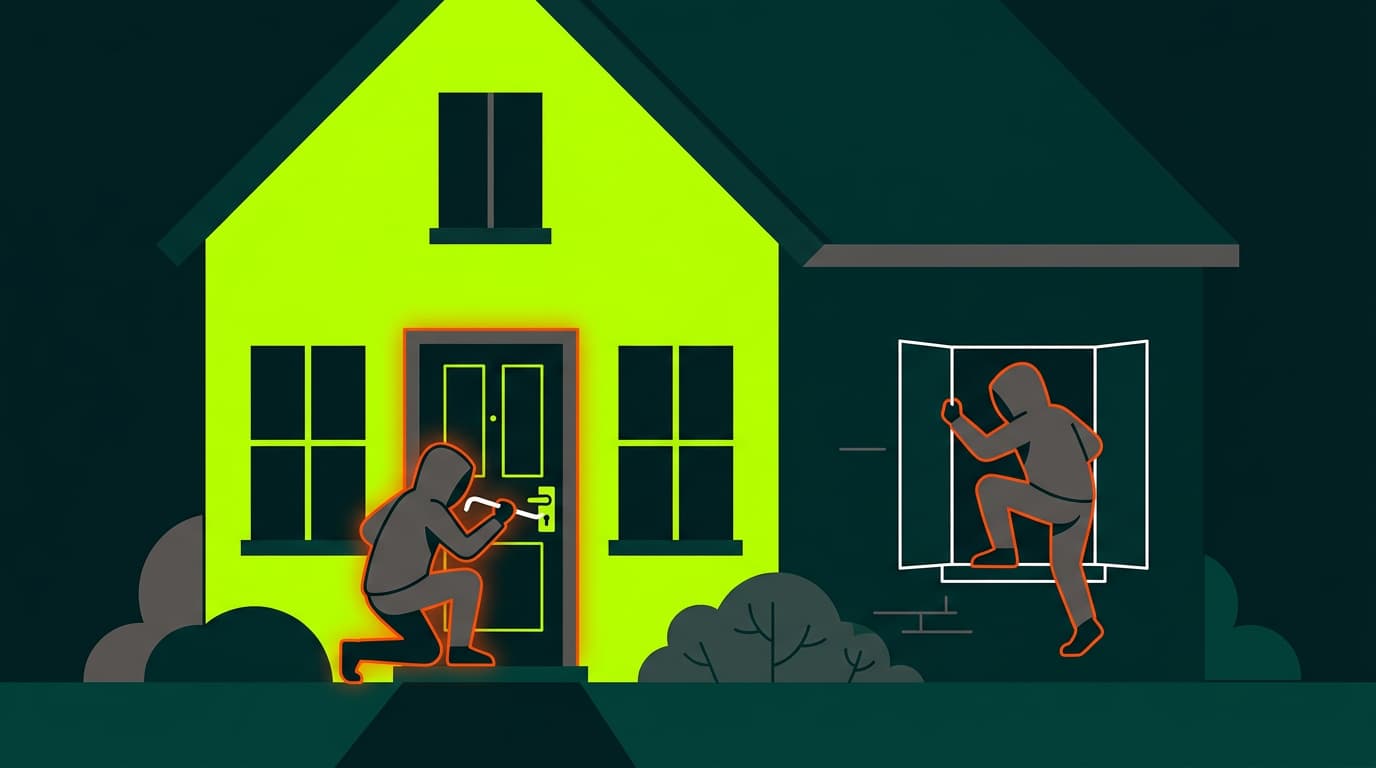
Discover the main types of home burglaries, the methods burglars use most often and how to protect your home effectively
Talking about the different types of burglaries is not about alarmism. It is about prevention. Understanding how burglars act, what they look for and why they choose a specific home is the first step towards reducing risk. In Spain, most home burglaries follow fairly clear patterns, and knowing them helps you stay one step ahead with realistic, effective measures.
In areas like ours, the Costa del Sol, where main homes, second homes and holiday rentals all coexist, these patterns are even more common. In this article, we will look at what is legally considered a home burglary, the main types of burglaries in Spain, the techniques used and, above all, how to protect your home intelligently.
Before looking at the different scenarios, it is worth clarifying what the law understands as burglary. Not every criminal act in a home is exactly the same, and not all have the same legal consequences.
What is considered a home burglary?
According to Article 237 of the Spanish Criminal Code, those who, for profit, take another person’s movable property using force to enter or leave the place where it is located, or violence or intimidation against people, either when committing the offence, to protect their escape, or against those who come to the victim’s aid or pursue them, are guilty of the offence of robbery.
Article 238 of the same text clarifies the following: those who commit the act when any of the following circumstances apply are guilty of robbery with force:
- Climbing.
- Breaking through a wall, ceiling or floor, or breaking a door or window.
- Breaking into cupboards, chests or any other closed or sealed furniture or objects, forcing their locks or discovering their codes to steal their contents, either at the place of the burglary or elsewhere.
- Use of false keys.
- Disabling specific alarm or security systems.
These specifications are important because they determine both the seriousness of the offence and the associated penalties within the types of burglaries covered by the Criminal Code.
Homes also have special protection under the Spanish Criminal Code. They are not just physical spaces, but people’s private sphere. This is why burglary in a home usually carries higher penalties than other property offences, even when the value of what has been stolen is not especially high.
Main types of home burglaries
When we talk about what types of burglaries exist in the domestic setting, they do not all follow the same pattern or require the same level of planning. Some are opportunistic, while others are highly organised. Let’s look at them one by one.
1. Forced-entry burglary
This is the most classic type and one of the most frequent. The burglar forces a door, window, grille or lock to enter the home. It can happen during the day or at night, although burglars often take advantage of long absences or predictable time slots.
This includes techniques such as using crowbars, breaking lock cylinders or forcing sliding windows. In many homes, especially older properties or those with basic locks, access can be gained in less than a minute when there are no additional security measures.
2. Burglary through carelessness or without forced entry
This type of burglary leaves no obvious signs of entry. Access happens because the door was not properly closed, a window was left open or a terrace could be reached from another property.
It is very common in summer, when people air the house or go out “just for a moment”. It also happens in villas or ground-floor homes with gardens. The problem is that many people do not realise the real risk behind these small lapses, even though they are one of the main opportunities burglars look for.
3. Burglary through deception
In this case, access is gained through the victim’s trust. The burglar pretends to be a technician, delivery driver, maintenance worker or even a neighbour.
Once inside, they can steal items quickly or make it easier for accomplices to enter later. This type of burglary often affects older people in particular, but it can happen in any home where identities are not properly checked.
4. Burglary with intimidation or violence
This is the most serious scenario and the one with the greatest psychological impact. The burglary takes place while the victim is present, using threats or direct violence.
Although it is less common than other types of home burglaries, the risk is much greater. It is often linked to prior observation of routines and schedules, which reinforces the importance of not making certain habits public.
5. Burglary in unoccupied homes
Second homes and properties left empty for months are clear targets. Burglars know that no one is going to detect the intrusion immediately, giving them more time to act.
On the Costa del Sol, this type of burglary is especially common outside peak season. Criminals look for clear signs of prolonged absence, such as overflowing letterboxes, blinds that are always down or a total lack of night-time activity.
6. Burglary planned by organised gangs
Here we are talking about professional crime. These gangs study the home, access points, schedules and security systems before acting.
They use vehicles, signal jammers, prior surveillance and divided roles. This type of burglary usually happens in homes with high-value items or in residential developments where several houses share similar characteristics.
Main home burglary techniques
Beyond the type of burglary, it is important to understand how they are carried out. Many techniques are silent and leave no visible damage, which delays detection.
1. Bumping
This involves inserting a manipulated key and tapping it gently to make the lock pins jump. It is fast, quiet and very effective on older locks or locks without anti-bumping systems.
2. Impressioning
This is a slower but precise technique. The burglar creates a copy of the key from the lock cylinder itself, marking the internal points until achieving a perfect opening.
3. Slipping
A very well-known and extremely simple method. A flexible sheet is inserted between the door and the frame to move the latch. It works on doors that are not properly locked with a security lock.
4. Climbing
Access is gained by climbing façades, patios or communal elements. It is common in ground-floor and first-floor flats with balconies that are accessible from the street or shared areas.
5. Lock picking
A classic technique that requires skill, but is still effective on simple locks. It leaves very little visible trace.
6. The magnet method
This is used to extract keys left near the door, such as under the doormat or in outdoor key boxes. Although it may seem obvious, it is still surprisingly common.
7. Door peephole manipulation
Some older peepholes can be removed from the outside, creating a small opening that allows the burglar to manipulate the inside of the door.
How to identify whether your home could be a burglary target
Not all homes have the same level of risk. Burglars look for ease, speed and a low chance of being detected.
A long absence or overly predictable routines are clear warning signs. If you always leave and return at the same time, the pattern is easy to spot. Poor outdoor lighting, especially around entrances and communal areas, also works against you.
Doors and windows with basic or worn locks indicate less resistance. Added to this are external signs such as strange marks near the doorbell, frame or letterbox, which are often used to check whether the home is occupied.
Tips to prevent home burglaries
Prevention is not just about fitting a better lock. It is about creating layers of security. The more barriers a burglar perceives, the more likely they are to rule out the property.
Combining physical measures with electronic systems is the most effective approach. A visible alarm, opening sensors and motion detection drastically reduce risk, especially when connected to an alarm receiving centre.
To explore this approach in more detail, you can read our article on how to prevent burglaries at home and understand which measures are genuinely effective today.
For complete protection, solutions such as Olin Protect make it possible to adapt security to both main homes and second homes, something particularly useful in seasonal areas.
What to do if your home is burgled
If a burglary happens despite all precautions, the most important thing is not to enter or touch anything if you notice signs of intrusion. Call the police immediately and document everything that is missing or damaged.
Afterwards, notify your insurance company and review the access points used so they can be reinforced. It is common for a home that has already been burgled to become a target again if its weaknesses are not corrected.
In this article, we explain step by step what to do if your home has been burgled and how to act to minimise legal and financial consequences.
Understanding the different types of burglaries, the most commonly used techniques and the risk factors helps you make informed decisions. Security is not about fear. It is about anticipation. Having a protection system adapted to your home can make the difference between being an easy target and being a house burglars decide to avoid.




Very Satisfied
The service is excellent, and we always pay the same amount. We’ve been customers for three years. The staff at the store are very professional and serve us in three different languages!