Discover what Wi-Fi 6E is, how it works and why it offers greater speed, stability and fewer interferences than earlier wireless technologies.
The Wi-Fi 6E standard is the most recent update to the wireless technology we use every day. Its main purpose is to add a new frequency band that reduces congestion in home networks and allows faster speeds.
This technology helps solve the saturation problems many households experience when multiple devices connect at the same time. By introducing a new transmission “lane”, your phone, computer and TV no longer compete for the same bandwidth.
In this article, we explain how it works, its advantages and which devices support this technology.
What Is Wi-Fi 6E?
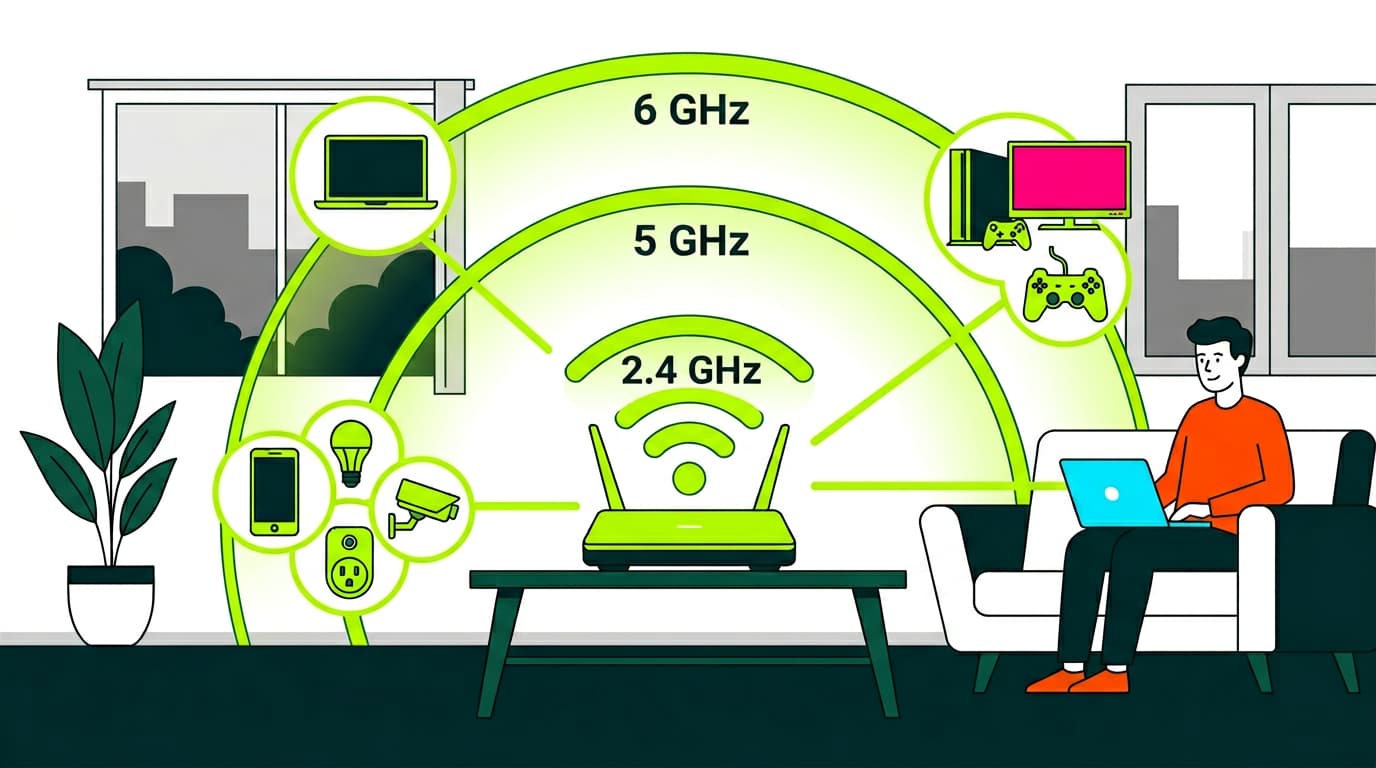
Wi-Fi 6E is an extension of the Wi-Fi 6 wireless standard (802.11ax) that enables the use of a new frequency band: 6 GHz. This means compatible routers and devices can transmit data across three different bands — 2.4 GHz, 5 GHz and 6 GHz — increasing the total capacity of the wireless network.
From a technical perspective, Wi-Fi 6E does not change how Wi-Fi 6 transmits data. It uses the same modulation technologies, device management systems and efficiency improvements of the 802.11ax standard. The key difference is access to an entirely new section of radio spectrum.
According to the Wi-Fi Alliance, the organisation responsible for certifying devices and ensuring they meet security and interoperability requirements, the 6 GHz band adds hundreds of megahertz of additional spectrum. This allows more channels to be created, and most importantly, wider channels capable of transmitting data at higher speeds with less congestion.
In practice, this results in faster wireless networks, lower latency and greater capacity to handle many connected devices at the same time.
It’s worth clarifying that this is not a completely new generation like Wi-Fi 7 will be. Instead, it is an important expansion of the current standard designed to handle the huge amount of data we consume today.
How Wi-Fi 6E Works
This technology works by using additional radio spectrum. The 6 GHz band provides far more space for data transmission than previous bands combined. Technically, this means the network can use wider channels. A channel works like a pipe through which data travels — the wider it is, the more information it can carry.
Wi-Fi 6E allows the use of up to seven channels of 160 MHz width. This is particularly useful for activities that require large amounts of data to move very quickly, such as virtual reality or 4K and 8K streaming. With more available channels, the router can manage traffic more efficiently. Devices no longer need to wait in a queue to send or receive information.
Another key feature of the 6 GHz band is that it is essentially clean spectrum. Older devices that only support Wi-Fi 4 or Wi-Fi 5 cannot access it. If your laptop connects to the 6 GHz band, its signal will not be affected by older devices, microwaves, baby monitors or neighbouring routers.
To fully benefit from this, your home also needs a strong bandwith. An ultra-fast wireless network cannot perform at its best if the broadband connection reaching your home is slow.
Main Advantages of Wi-Fi 6E
Adopting this technology at home is not just about having the latest hardware. It delivers real improvements in everyday internet use.
Higher speeds and greater capacity
The most obvious benefit is raw speed. Thanks to wider channels and a less congested frequency band, downloads are significantly faster. You can transfer large files in seconds or watch films in maximum resolution without buffering interruptions. It delivers an experience very close to using an Ethernet cable — but without the cable.
Less interference and lower latency
Latency refers to the time it takes for data to travel from your device to the network and back. High latency can cause noticeable delays in online gaming or video calls. Wi-Fi 6E greatly reduces this delay. Because the 6 GHz band is free from interference from older devices, communication becomes far more responsive. This results in clearer video calls without interruptions and smoother competitive online gaming.
More connected devices without slowing down
Wi-Fi 6E uses technologies such as OFDMA (Orthogonal Frequency-Division Multiple Access), which allows the router to communicate with several devices simultaneously in a single transmission. Previously, routers handled devices one at a time, even if the process was very fast. Now they can send data to your phone, tablet and console at the same time. This prevents the network from feeling slow when the whole household is connected.
Improved security with WPA3
Security is another important improvement. For a device to receive Wi-Fi 6E certification, it must support the WPA3 security protocol. WPA3 is significantly more robust than the previous WPA2 standard. It makes it much harder for intruders to guess your password through brute-force attacks.
If protecting your home Wi-Fi network is a concern, this standard adds an extra layer of reassurance. Data encryption is stronger, helping safeguard your private information on the local network.
Discover our broadband offers
What Devices Support Wi-Fi 6E?
To benefit from these improvements, it’s not enough for your router to broadcast on the 6 GHz band. The devices connecting to it must also support Wi-Fi 6E.
Most high-end smartphones released in recent years already include support for this band. Recent models from Samsung, Google Pixel and Apple (from the iPhone 15 Pro onwards) connect without issues. Many modern laptops also include compatible network cards. If you use a desktop computer, you can upgrade it by installing a PCIe network card or a modern USB adapter.
Next-generation consoles and some high-end smart TVs are also beginning to adopt this standard. However, simple smart-home devices such as bulbs or smart plugs usually still rely on the 2.4 GHz band. This is not a problem, as Wi-Fi 6E routers are backwards compatible. They broadcast simultaneously on 2.4 GHz, 5 GHz and 6 GHz, allowing older devices to continue working normally.
Differences Between Wi-Fi 6 and Wi-Fi 6E
These two terms are often confused because they share the same technical foundation. Both use the 802.11ax standard, meaning they manage data in the same efficient way. The key difference lies in the available frequency bands.
Standard Wi-Fi 6 is limited to 2.4 GHz and 5 GHz, which must be shared with older technologies such as Wi-Fi 4 and Wi-Fi 5. This means even a powerful Wi-Fi 6 router can slow down if those frequencies are crowded.
Wi-Fi 6E, by contrast, moves that same technology into a clear spectrum. The transmission technology remains the same, but the environment is far less congested.
Another important difference involves channel management. In Wi-Fi 6, finding a free 160 MHz channel in the 5 GHz band can be difficult due to radar regulations and other restrictions. In the 6 GHz band used by Wi-Fi 6E, these wide channels are readily available. This makes it much easier to reach the maximum theoretical speeds advertised by router manufacturers.
Discover our broadband offers
The Future of Wi-Fi: Wi-Fi 7
Wireless technology continues to evolve rapidly, and the next step is already on the horizon.
Wi-Fi 7, technically known as 802.11be, promises even higher speeds. This future generation will double channel bandwidth to 320 MHz and improve modulation to carry more data within the same signal.
However, for most households today, upgrading to Wi-Fi 6E is the most practical option. Wi-Fi 7 infrastructure is still expensive and there are very few compatible devices.
Investing in a Wi-Fi 6E system now ensures excellent connectivity for years to come, easily supporting 4K streaming, remote work and modern gaming.
Discover our broadband offers
n short, if you want real speed and stability at home, upgrading your equipment is a smart move.
The 6 GHz band removes many of the interference issues common in apartment buildings with many neighbouring networks. With Wi-Fi 6E, your high-speed broadband connection can perform at its full potential, allowing you to enjoy smooth, reliable internet across all your compatible devices.





Very Satisfied
The service is excellent, and we always pay the same amount. We’ve been customers for three years. The staff at the store are very professional and serve us in three different languages!