


Olin > Blog > What Is Quantum Internet? Applications and Future
What Is Quantum Internet? Applications and Future
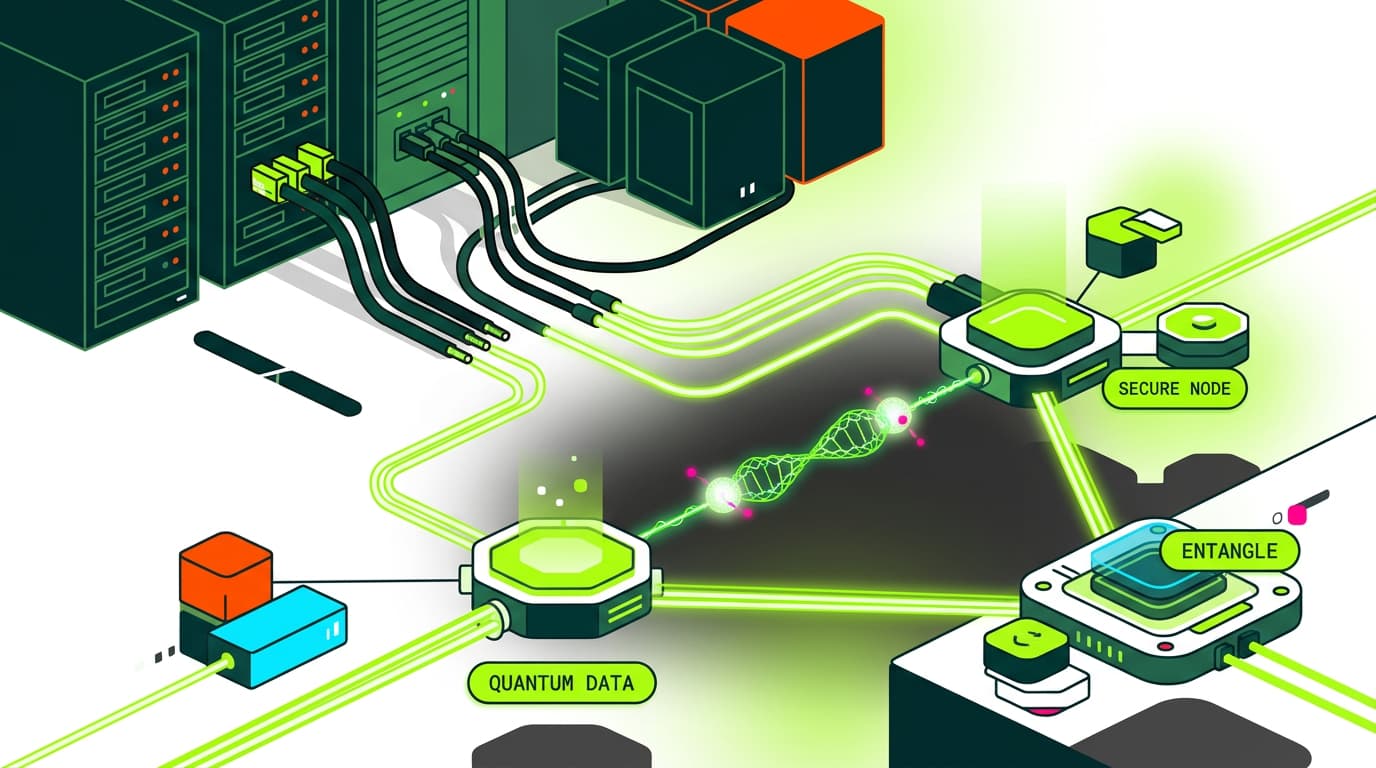
Quantum internet is set to transform how we communicate and protect data. Discover what it is, how it works, and its real-world applications.
Can you imagine an internet that is impossible to hack? Or sending information instantly between two points, regardless of distance?
Quantum internet is set to transform how we communicate and process information in ways that, until recently, felt like science fiction. While traditional broadband transmits data through light pulses, this new approach relies on the unusual properties of quantum mechanics to create something entirely different.
What Is Quantum Internet?
Quantum internet represents the next step in the evolution of digital communications. Unlike today’s internet, which relies on classical bits (0s and 1s), quantum internet uses qubits — units of quantum information that can exist in multiple states at the same time thanks to a phenomenon known as superposition.
What truly sets it apart is quantum entanglement. This describes pairs of particles that are so deeply connected that, no matter how far apart they are, a change in one instantly affects the other.
This principle forms the foundation of quantum networks and is what makes them fundamentally different from current high-speed broadband technologies.
What Is Quantum Internet Based On?
Quantum internet relies on three core principles of quantum mechanics:
- Superposition: A classical bit can only be 0 or 1. A qubit can exist in both states simultaneously, dramatically increasing processing capacity.
- Entanglement: This allows pairs of particles to remain perfectly correlated, enabling the transfer of quantum states between them.
- No-Cloning: It is impossible to create an exact copy of an unknown quantum state. This makes data inherently secure against interception.
Applications of Quantum Internet
The potential applications of quantum internet are both wide-ranging and transformative. Just as broadband reshaped telecommunications, this technology could go even further.
Quantum Cryptography: Imagine a banking network that cannot be compromised. Any attempt to intercept the data would immediately disrupt it. This is made possible through quantum key distribution (QKD).
Distributed Computing: Quantum networks could connect multiple quantum computers, creating powerful virtual systems capable of solving complex problems in areas such as drug development or climate modelling.
Quantum Sensors: Highly sensitive, interconnected sensors could improve early earthquake detection or enable more accurate medical diagnostics.
The Future of Quantum Internet
Development is moving quickly. China has already launched the first quantum communication satellite, while the European Union has committed over €1 billion to its Quantum Flagship initiative.
However, just as deploying broadband required dedicated infrastructure, quantum internet will need its own systems — including quantum repeaters and memory technologies. Experts expect the first commercial quantum networks to appear within the next decade, initially focused on sectors like banking and government security. Over time, and much like the shift from ADSL to broadband, adoption will gradually expand.
To stay up to date with the latest developments in connectivity — and understand how to prepare for what’s next — explore more about broadband and network technologies on our blog.

Very Satisfied
The service is excellent, and we always pay the same amount. We’ve been customers for three years. The staff at the store are very professional and serve us in three different languages!