


Olin > Blog > Mobile fast charging: what it is and how it works
Mobile fast charging: what it is and how it works
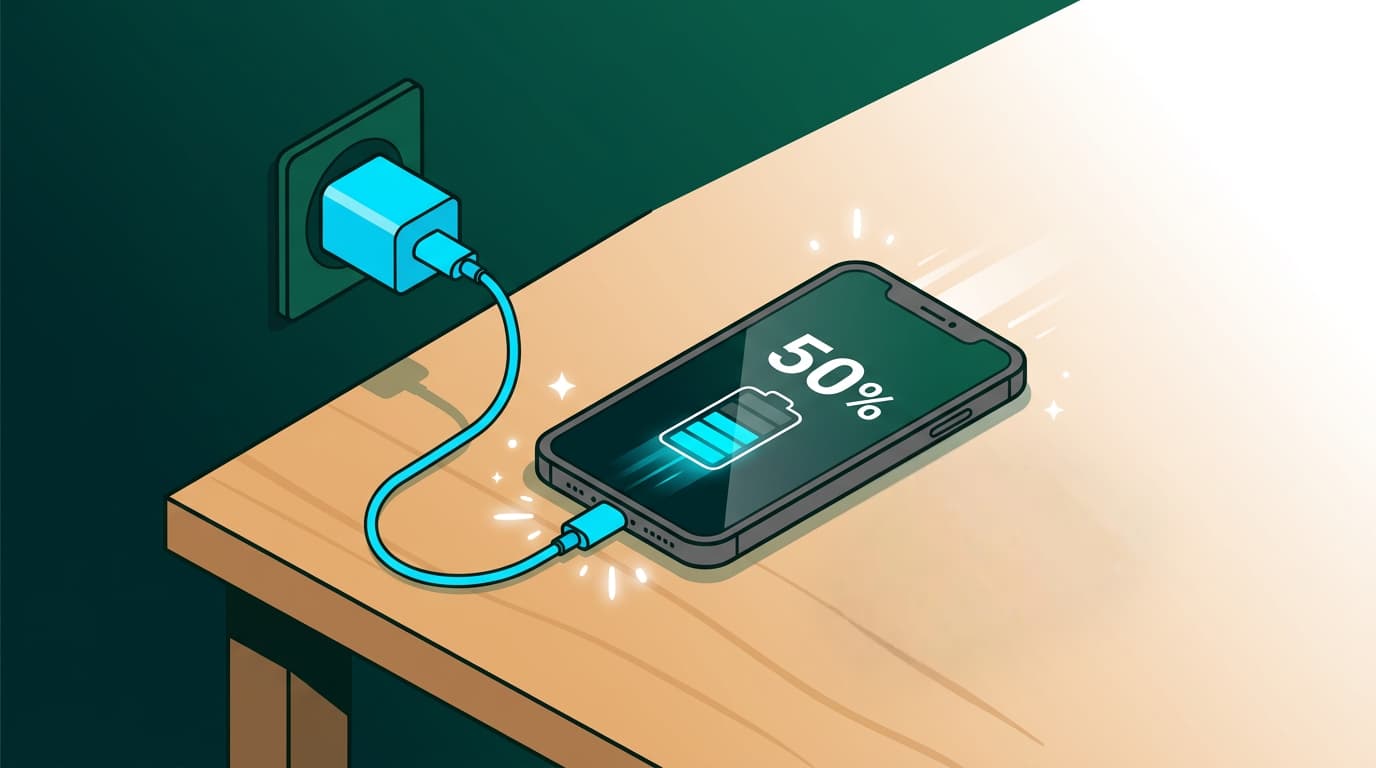
Mobile fast charging reduces the time it takes to charge your phone. Learn how it works, its benefits and whether it is safe
Imagine you are leaving home with your phone at 5% battery. Ten years ago, that meant a race against time. Now, thanks to mobile fast charging, you can recover 50% battery in less than 15 minutes. But how exactly does this technology work? Is it safe? Do all phones support it? In this article, we break down the technical secrets behind an advance that has changed the way we use our devices.
What is mobile fast charging?
Mobile battery fast charging is not magic. It is precision engineering. It is a system that increases charging power, measured in watts, to drastically reduce recharge times. While a standard charger usually works between 5W and 10W, fast charging systems can reach up to 240W, charging 100% of the battery in 9 minutes and 30 seconds.
But it is not just about raw power. This technology needs smart coordination between four elements:
- The charger, which must support high voltages and currents.
- The cable, specially designed to prevent overheating.
- The phone battery, with optimised chemical compositions, such as lithium-ion batteries with silicon anodes.
- The management software, which regulates energy flow in real time.
How does it work?
The key mechanism lies in Joule’s law: Power (W) = Voltage (V) x Current (A). To increase power, you can raise the voltage, the current, or both. However, each approach comes with its own challenges:
- Increasing the voltage, for example from 5V to 9V or 12V, requires converters inside the phone to adapt the energy to the battery, which generates heat.
- Increasing the current, for example from 2A to 5A, requires thicker cables and reinforced connectors to prevent energy loss.
Brands have developed their own protocols to optimise this balance:
- Qualcomm Quick Charge 5: up to 100W, compatible with USB-PD
- USB Power Delivery (PD): a universal standard that reaches 240W
- OPPO SuperVOOC: 150W with a dual-cell battery system connected in series
One crucial detail: the first 80% charges faster than the final 20%. This is because the last stages require lower power to protect battery health. That is why many manufacturers highlight figures such as “0–50% in X minutes”.
How much time does fast charging really save?
Let’s compare specific data using the OnePlus 10T with 150W charging against a traditional 15W charger:
|
Charge % |
150W fast charging |
15W standard charging |
|
0% a 50% |
5 minutos |
35 minutos |
|
0% a 100% |
19 minutos |
1h 45 minutos |
That means an 82% saving on a full charge. For users who charge their phone 1.5 times a day on average, mobile fast charging can free up more than 60 hours a year in waiting time.
Does your phone support fast charging? How to check
Having a powerful charger is not enough. Mobile fast charging compatibility depends on three factors:
- Device hardware: The charging circuit must support high voltages and amperages. For example, the iPhone 14 Pro Max accepts up to 27W, while the Xiaomi 13 Pro reaches 120W.
- The right cable: Fast charging USB-C cables usually have an identification chip, known as an E-Marker, which supports up to 5A. A standard 2A cable would limit the power.
- Management software: Systems such as Google Pixel’s Adaptive Charging slow down overnight charging to protect the battery.
Steps to check compatibility:
- Check your model’s technical specifications on the manufacturer’s website.
- Look for logos such as “Quick Charge”, “SuperCharge” or “HyperCharge” on the charger.
- Use apps such as Ampere on Android to measure the real charging current.
Safety in mobile fast charging
The fear that fast charging damages the battery is common, but unfounded when original components are used. Modern systems include up to 12 protection measures:
- Real-time temperature control, with sensors every 0.5 seconds.
- Dynamic power adjustment according to heat.
- Protection against overvoltage, short circuits and overcurrent.
A Battery University study shows that charging to 100% with 30W instead of 5W only reduces battery life by 3–5% after 500 cycles. To minimise the impact:
- Avoid charging your phone in direct sunlight or on surfaces that retain heat.
- Use removable cases during charging.
- Do not leave your phone connected at 100% for hours
Mobile fast charging has gone from being a luxury to becoming a necessity in our hyperconnected lives. Technologies such as 50W fast wireless charging and solid-state batteries are already promising full recharges in just 3 minutes.
At Olin, we do not just offer great mobile plans with unlimited data so you can get the most out of your device. We also have broadband solutions of up to 1Gbps so your app downloads and updates do not keep you waiting.
Because in 2025, time is still your most valuable resource.


Very Satisfied
The service is excellent, and we always pay the same amount. We’ve been customers for three years. The staff at the store are very professional and serve us in three different languages!