


Olin > Blog > Types of broadband cables and how they work: the complete guide
Types of broadband cables and how they work: the complete guide
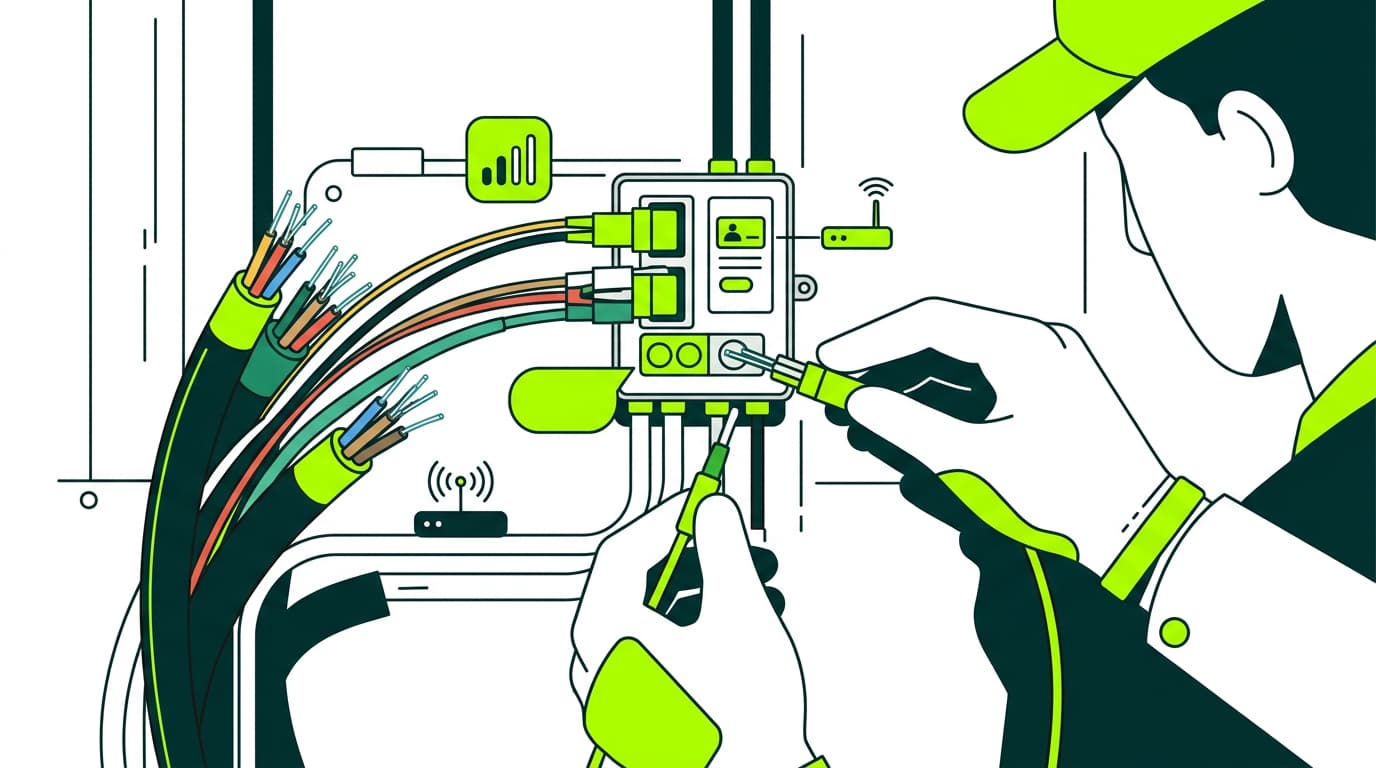
Learn about the different types of broadband cables, how they work, and which one is right for your connection. A clear and practical guide.
In today’s digital environment, broadband has become the standard for fast and reliable internet connections. But what actually sits behind those thin cables that carry data at incredible speed?
In this guide, we take a closer look at the different types of broadband cables and explain how they work.
How do broadband cables work?
Before looking at the different types, it helps to understand the basics. Broadband technology uses pulses of light to transmit data through extremely thin strands of glass or plastic.
Think of it as a very fine tube, even thinner than a human hair. This tube is called the core, and it’s surrounded by a layer known as the cladding, which has different optical properties. When light travels through the core, it reflects off the cladding, staying inside the cable and moving over long distances with very little signal loss.
This allows broadband to deliver faster speeds and greater stability than traditional copper cables, without electromagnetic interference.
Want to know more?
Types of broadband cables: single-mode and multi-mode
Broadband cables are usually divided into two main categories: single-mode and multi-mode. Each is designed for specific uses.
What is single-mode broadband?
Single-mode broadband (SMF) is designed to carry a single light signal. It has a very small core (around 8–10 microns), which allows light to travel in a straight path with minimal dispersion.
OS1
OS1 cables are typically used indoors. Their structure makes them more resistant to bending, which is useful in building installations.
OS2
OS2 is an improved version, designed for long-distance transmission. It offers lower signal loss, allowing data to travel further without degradation.
Single-mode broadband is ideal for long distances and high-capacity networks, such as connections between cities or countries.
What is multi-mode broadband?
Multi-mode broadband (MMF) has a larger core (usually 50 or 62.5 microns), allowing multiple light signals to travel at the same time.
OM1
An older type with a 62.5-micron core. Still in use, but gradually being replaced.
OM2
Improves performance over OM1, commonly used for 1 Gigabit Ethernet.
OM3
Laser-optimised and designed for higher bandwidth. Suitable for 10 Gigabit Ethernet.
OM4
An enhanced version of OM3, supporting longer distances and higher performance.
OM5
The latest generation, designed for wavelength division multiplexing (WDM), allowing multiple signals over different wavelengths.
Multi-mode broadband is more cost-effective and commonly used for shorter distances, such as local networks and data centres.
Standard wavelengths in broadband cabling
Wavelength plays a key role in performance. The most common are:
-
850 nm: Used mainly in multi-mode broadband for short distances
-
1300 nm: Suitable for medium distances
-
1310 nm: Used in single-mode broadband for long distances
-
1550 nm: Designed for very long-distance transmission
Difference between 850 nm and 1300 nm broadband
The main difference comes down to distance and signal loss:
-
850 nm: Shorter reach, more affordable, ideal for local networks
-
1300 nm: Longer reach, lower attenuation, better for medium distances
Types of broadband connectors
Connectors are essential in any installation. The most common include:
-
SC (Subscriber Connector): Known for its push-pull design
-
LC (Lucent Connector): Smaller, ideal for high-density equipment
-
ST (Straight Tip): Uses a bayonet-style connection
-
FC (Ferrule Connector): High precision, used in telecom environments
The right connector depends on the cable type, application and equipment.
Uses and applications of broadband cabling
Broadband cabling is used across many sectors:
-
Telecommunications and long-distance networks
-
Business networks and data centres
-
Medical equipment and imaging systems
-
Industrial automation
-
Military and aerospace communications
Why quality materials matter in broadband installation
Using high-quality materials is essential for a reliable connection. Good installation helps to:
-
Reduce signal loss
-
Lower maintenance needs
-
Extend system lifespan
-
Improve resistance to environmental factors
-
Maintain consistent speeds
At Olin, we focus on delivering dependable broadband using proven installation methods and high-quality materials, so your connection stays fast and stable over time.
Understanding the different types of broadband cables and how they work makes it easier to choose the right solution.
Whether you’re setting up a connection at home or for your business, having a clear picture of the technology behind it helps you make better decisions.
If you’re ready to upgrade your connection, Olin can help you bring reliable broadband to your home or business on the Costa del Sol.



Very Satisfied
The service is excellent, and we always pay the same amount. We’ve been customers for three years. The staff at the store are very professional and serve us in three different languages!