


Olin > Blog > What is FTTH (Fiber To The Home)?
What is FTTH (Fiber To The Home)?
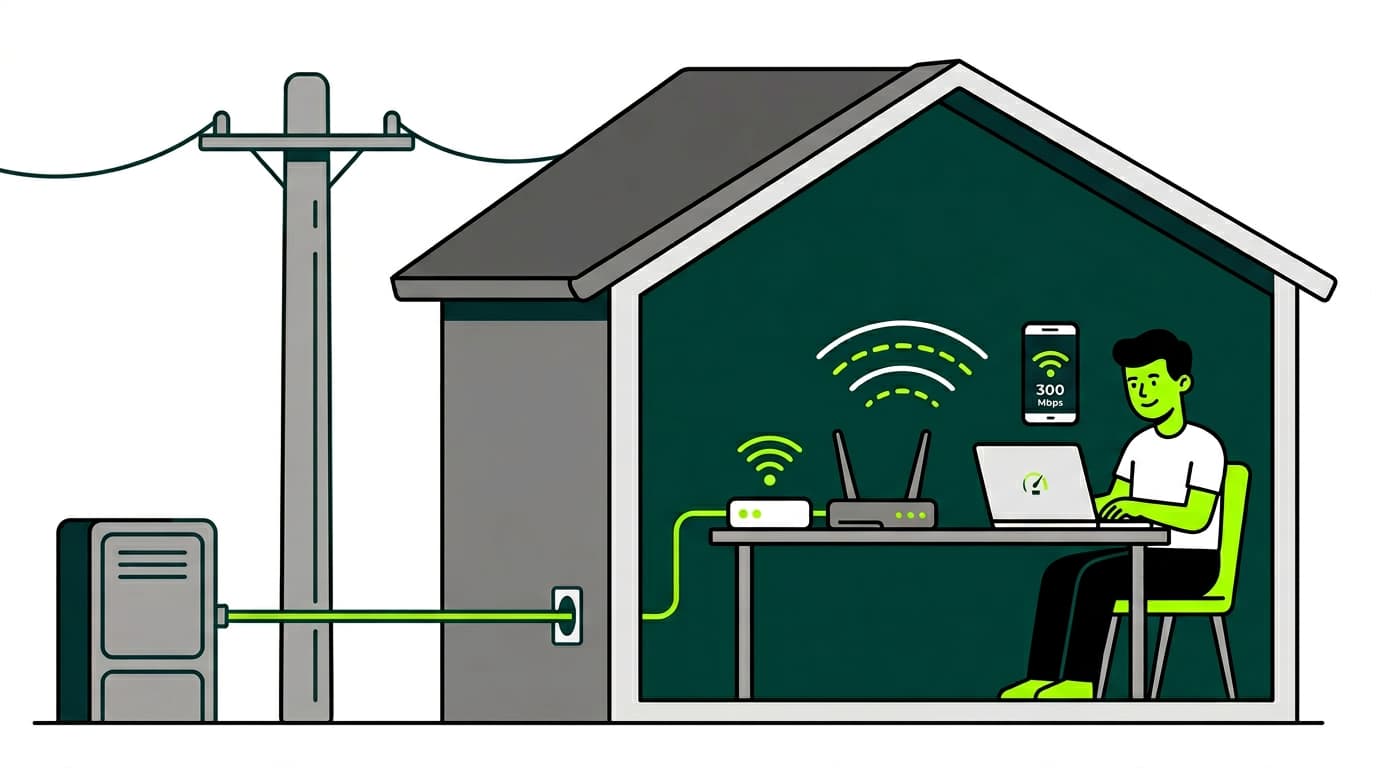
FTTH, or Fiber To The Home, refers to the installation and use of optical fibre from a central point directly to your home. Let’s take a closer look.
Have you ever wondered what those mysterious initials really mean? FTTH (Fiber To The Home) is the technology that’s transforming the way we connect to the internet. If you want to stay ahead and enjoy a smooth, high-performance online experience, this guide is for you.
Let’s dive into how FTTH works and why it plays such an important role in modern broadband connections.
What is FTTH and what is it used for?
FTTH stands for Fiber To The Home, meaning that optical fibre runs directly from the provider’s network to your home. This allows you to enjoy an ultra-fast, high-quality broadband connection.
With FTTH, you get much higher download and upload speeds compared to older technologies like ADSL. That’s one of the key reasons why FTTH-based broadband clearly outperforms copper-based connections.
Types of FTTH connections
Depending on how the fibre network is deployed, there are different FTTH architectures. The most common are:
-
PON (Passive Optical Network): The most widely used option. A single fibre cable is shared among multiple homes using passive optical splitters.
-
AON (Active Optical Network): Uses active equipment such as switches to distribute the signal. It’s less common than PON.
How does FTTH work?
FTTH uses optical fibre cables to transmit data as pulses of light. This approach delivers unmatched speed and efficiency. Here’s how it works step by step:
1. Signal origin
Everything starts at the internet provider’s central office. Data is converted into light pulses using lasers or LEDs.
2. Transmission through optical fibre
These light pulses travel through optical fibre cables made of extremely pure glass or plastic. The light reflects internally along the fibre, allowing signals to travel long distances with minimal loss.
3. Transmission speed
Data travels at close to the speed of light (around 300,000 km/s), meaning information can cross the country in milliseconds.
4. Arrival at your home
The fibre reaches your home directly, where an ONT (Optical Network Terminal) is installed. This device converts light signals into electrical signals your router can understand.
5. Distribution inside the home
From the router, the broadband connection is distributed to all your devices, either via Ethernet cables or Wi-Fi.
The process is bidirectional. When you upload data, the steps are reversed: your router sends electrical signals, the ONT converts them into light pulses, and they travel back to the provider’s network.
Unlike copper-based technologies such as ADSL, FTTH broadband does not degrade over distance, ensuring consistent speed and quality.
FTTH network architecture and components
An FTTH network includes several key elements:
-
OLT (Optical Line Terminal): Located at the provider’s central office, responsible for sending and receiving optical signals.
-
ONT (Optical Network Terminal): Installed in your home to convert optical signals into usable data.
-
Optical splitters: Used in PON networks to distribute a single fibre connection to multiple homes.
Benefits of FTTH broadband
FTTH offers clear advantages over other broadband technologies:
-
Ultra-fast speeds: Download speeds of 1 Gbps or more, ideal for large files, streaming, and cloud services.
-
Low latency: Perfect for online gaming, video calls, and real-time applications.
-
High bandwidth: Multiple devices can connect at the same time without performance drops.
-
Stability: Optical fibre is resistant to interference, providing a more reliable connection.
FTTH coverage in Spain
FTTH deployment has grown rapidly in Spain. According to data from the CNMC (National Commission on Markets and Competition):
-
By February 2024, FTTH lines reached 15.6 million, with a monthly increase of over 100,000 new connections.
-
Year-on-year growth exceeded 1.1 million FTTH lines.
-
At the same time, older technologies like ADSL continue to decline.
This expansion highlights how FTTH-based broadband has become the standard for high-speed internet in Spain.
If you want to check whether your home already has FTTH coverage, take a look at our guide on how to check broadband availability at home.
FTTH vs FTTN and FTTC
It’s important to distinguish FTTH from similar technologies:
-
FTTN (Fiber To The Node): Fibre reaches a street cabinet, with copper used for the final stretch. Speeds are lower than FTTH.
-
FTTC (Fiber To The Cabinet): Fibre reaches a closer cabinet, but still relies on copper to reach the home.
Both options offer improved performance compared to ADSL, but neither matches the speed, stability, or capacity of FTTH broadband.
FTTH is currently the most advanced broadband technology available. With its ultra-fast speeds, low latency, and exceptional reliability, it’s the best choice for anyone who wants top-tier internet performance at home.
At Olin, we’re committed to bringing next-generation broadband directly to your door. If you’d like to learn more or check availability in your area, get in touch with us — we’ll be happy to help.

Very Satisfied
The service is excellent, and we always pay the same amount. We’ve been customers for three years. The staff at the store are very professional and serve us in three different languages!